“These creative reimaginings of blogs have quietly taken nerdier corners of the internet by storm. A growing movement of people are tooling with back-end code to create sites that are more collage-like and artsy, in the vein of Myspace and Tumblr—less predictable and formatted than Facebook and Twitter.”
“Digital gardens explore a wide variety of topics and are frequently adjusted and changed to show growth and learning, particularly among people with niche interests. Through them, people are creating an internet that is less about connections and feedback, and more about quiet spaces they can call their own.”
“With blogging, you’re talking to a large audience,” (Tom Critchlow) says. “With digital gardening, you’re talking to yourself. You focus on what you want to cultivate over time.”
The author of this post ends by wondering if it will hit critical mass – like that is something to aim for. I don’t think so and I hope not. When something becomes mainstream it is co-opted by capitalism and neurotypical social norms. This is exactly what happened to blogging when it went from something nerds did for love and passion to a revenue stream.
Do we get stuck because we see the whole finished thing in our minds?
Is it executive function or is it GCP?
Do we struggle to find a way in because we are not sequential thinkers and seeing the whole is overwhelming?
Can Iteration be a tool?
The idea does not have to come out fully formed.
What about “rejection sensitivity?”
Could this be happening because we are reliving every rejection we’ve ever experienced? Does it also happen when we are already struggling with flaws (deviations from our internal gestalt) and someone points them out or criticizes it’s unbearable?
How can we rewrite our gestalts?
Can we make more space for imperfection, experimentation, iteration, and discovery?
I think I’ve done this with gardening and pottery and it’s all to do with who I learned those things from and how I think about them. Can I invite that sense of ease and curiosity into other pursuits?
“A garden is a collection of evolving ideas that aren’t strictly organised by their publication date. They’re inherently exploratory – notes are linked through contextual associations. They aren’t refined or complete – notes are published as half-finished thoughts that will grow and evolve over time. They’re less rigid, less performative, and less perfect than the personal websites we’re used to seeing.”
As someone who struggles with perfectionism and can get caught up in finding the right container a wild digital garden sounds like a particularly fertile project for me.
“Gardens present information in a richly linked landscape that grows slowly over time… You get to actively choose which curiosity trail to follow, rather than defaulting to the algorithmically-filtered ephemeral stream. The garden helps us move away from time-bound streams and into contextual knowledge spaces.”
This metaphorical contrast of a constantly flowing stream (like social media) versus following your own curiosity down various rabbit holes reminds me of my early days of the internet and an experience I’d like to get back to.
When I realized I wanted to reframe my artist’s log project as a digital garden (or compost heap) it was clear to me that my newsletter was more of a campfire… a space for connection.
Then I continued reading to find this,
“While gardens present the ideas of an individual, campfires are conversational spaces to exchange ideas that aren’t yet fully formed.”
Love it when a metaphor comes together.
And just when I was wondering if maybe it wasn’t all a bit frivolous and I was being distracted from the real work Appleton says,
“Naming is a political act as much as a poetic one.”
“[Digital gardens] are online spaces where you can collect or share information…an organically grown collection of ideas, resources, and thoughts. It’s a place that you can create online that encourages continuous learning, exploration, and growth, much like tending to a physical garden. It’s a living ecosystem of interconnected insights where the ideas and concepts can bloom, cross-pollinate, or sometimes wither away. Unlike a static blog post or article that presents a finished thought, a digital garden’s content is often in a constant state of growth and environment.”
I was immediately intrigued. This integrates nicely with my own ideas about creative ecosystems and creative compost.
I love colloquialisms so I just ordered the audiobook of Landmarks by Robert McFarlane based on a recommendation with these examples from Robin Sloan:
ammil a Devon term for the fine film of silver ice that coats leaves, twigs, and grass when freeze follows thaw
This is something we see a lot in the American south and I am always enchanted by!
sìth “a fairy hill or mound,” is a knoll or hillock possessing the qualities which were thought to constitute desirable real estate for fairies — being well-drained, for instance, with a distinctive rise, and crowned by green grass.
As Robin says – the roots of Darth Vader there.
smeuse a Sussex dialect noun for “the gap in the base of a hedge made by the regular passage of a small animal.”
Dying to hear how this one is said. He recommends a paper copy for the glossary, but I really want to hear how these words are pronounced.
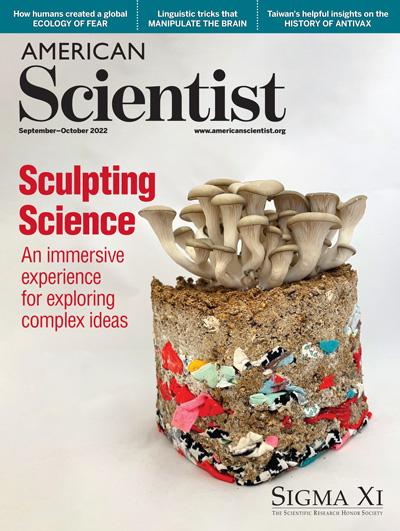
Textile artist Minga Opazo creating work with textile waste. Some of her work incorporates mushrooms to explore solutions for dealing with waste.
In her practice, she is dedicated to research the textile industry further and to create work that exposes, reflects and finds a solution to the current situation of the textile waste industry.
…one of the reasons that I got into growing mushrooms into my sculptures and having grass into my sculptures is that when I made one of the first sculptures, there were layers of mud and clothing. I made it with dirt from the outside. It was already outside my studio. And it started naturally growing because it was wet. …“Oh, what happens if I start growing stuff in my sculptures?” And having this conceptual moment between nature and the sculptures…The pieces do what they want to do. So it’s a collaboration between nature and my work.
Even as a kid I would collect notes and information, magazine pages, booklets. I think it’s something of a neurodivergent impulse. Autistic folks often love collecting things and I’ve only just realized that part of that drive for me is in collecting information. I love learning things, but I also love cataloguing what I’m learning.
(Important to note this is not a universal love among autistics. There are a lot of different ways our passions and interests can show up.)
Through the years I’ve tried on different styles of note taking, but I’ve always loved the idea of a centralized system. The problem is I kept trying on other people’s systems and they were never the quite right fit.
Recently, I’ve been working out how to create my ideal note taking system.
A caution, dear reader, not to try and recreate my own system for yourself. But I hope by sharing this it can shatter some misconceptions about research and note taking and open up the realm of possibilities to you.
If you’ve been around for a while you’ll notice this is kind of an amalgamation of several different note taking projects I have had. Gathering up everything under one roof as it were. Over the years I have tried: physical notebooks, file folders, the Pocket app, Evernote app, traveler’s notebooks, blog posts, podcasts, Notion, and finally a library card catalogue drawer. Each of those attempts was, in a way, trying to create a system that I saw outside of myself and they were all too rigid.
My new system is a digital analogue hybrid.
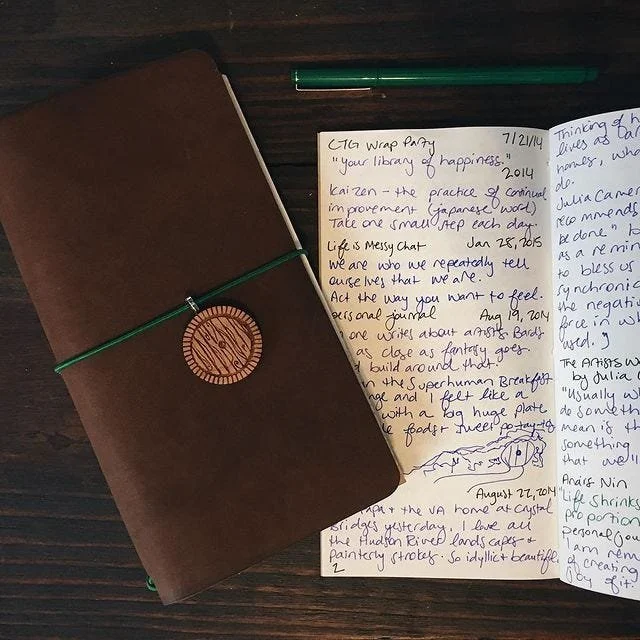
I love handwriting notes. Typing them. Shuffling around papers. For years my ideal system (the one of my university mentor) was a series of matching composition notebooks. (1)
Then it was digital. I went “all in” on Evernote and it didn’t take long to reach the threshold where they wanted to charge a monthly fee. I think I was between degrees at this point and couldn’t imagine paying for that so I pivoted back to paper again.
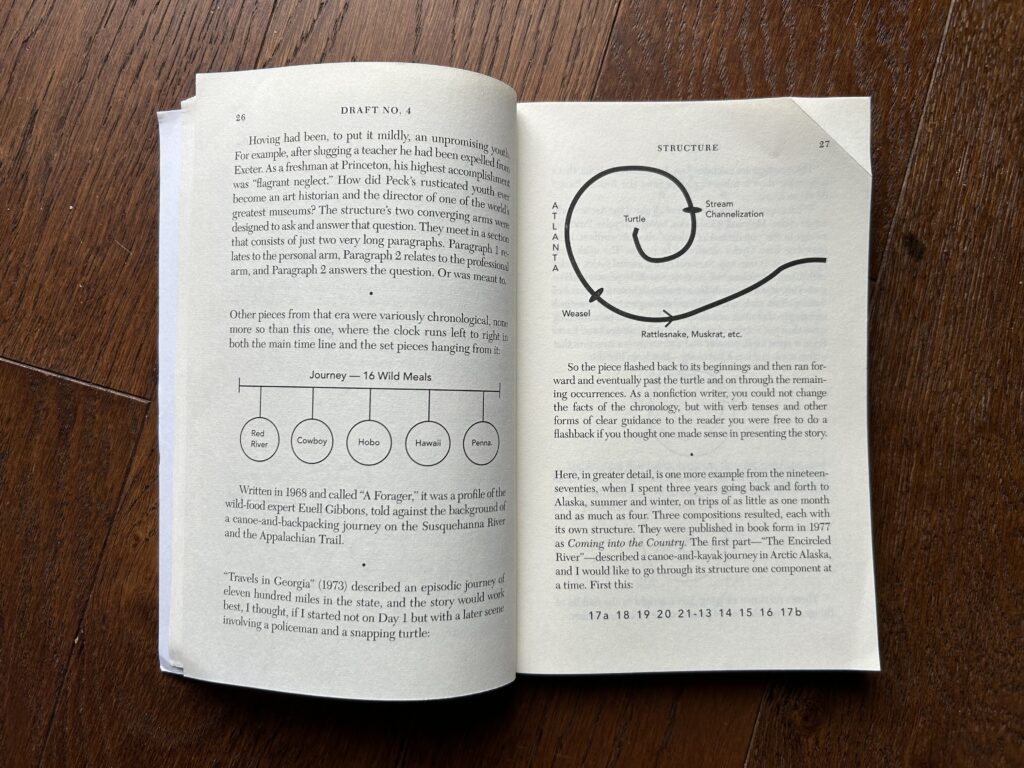
Austin Kleon blogged about commonplace books and I was hooked. I tried to create a color coded indexing system. I tried numerical systems.
The trouble with notebooks is no matter what kind of system you use it can be hard to find what you’ve recorded in the past. (2)
After a while I gave up on that and started sharing monthly updates on Patreon. A round up of everything I’ve read, watched, or listened to with some of my favorite quotes.
I always circle back to physical though. Early 2019 I tried a physical notebook to document what I wanted to share to Patreon. This was shortly before Davy was born and it quickly went out the window.
But the digital format survived. It lives on as my newsletter.
The trouble is when I’m really in research collecting mode I have more than I can reasonably share in this format. And it’s also not easily search-able.
So in 2020 I started a Notion. That also has stuck with me, but there are some caveats.
It’s a third party app that could disappear or start charging at any moment.
And I haven’t kept up with cataloguing the details like I did in the beginning and it’s starting to become a bit of a tangled mess.
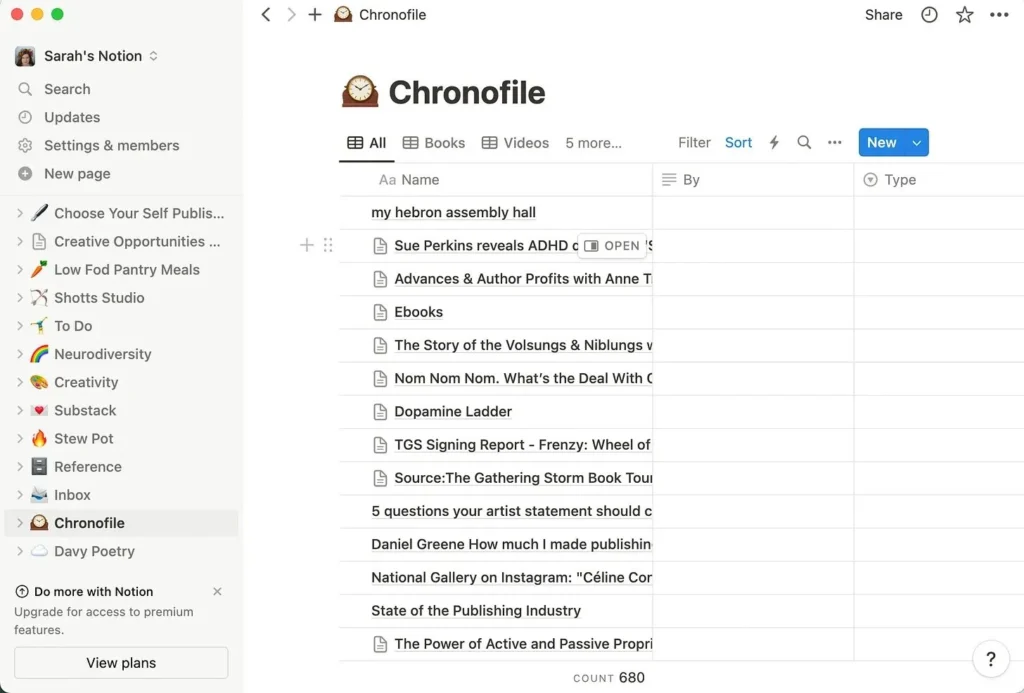
Part of the problem is I created this system when Davy was still napping in my lap a lot. So I had ages to poke around on my phone. Now I have other things to do and this type of cataloguing is not at my top of priorities. Here’s a screenshot where you can see I no longer take the time to fill out “by” and “type” which are kind of essential when it comes to finding what I’m looking for.)
So I swing back analogue…
When Davy started school I read yet another book about note taking and I fell in love with the idea of writing or typing up all my notes on index cards in my “free time.” But Davy was only in school for half days and by the time you take the commute into account I was lucky to get a couple of hours each day. I spent most of them writing a book and making art.
Now we’re home educating so it’s all a muddle of life and creativity without any clearly delineated “studio time.
If you’re neurodivergent you may have a similar cycle…
Get excited by a project.
Find a creative spark to create a system.
Abandon system.
Feel guilty.
But something was different this time around.
In all of the research about neurodiversity and autism to support David I am learning to support myself. And to reframe my perceived “deficits” as differences.
Instead of feeling guilty I got curious.
Why did some methods work better than others? What would really work best for me?
When I switched up my Substack schedule I freed up some mental bandwidth.
That extra capacity is really key here. I rarely innovate when I’m at capacity.
The second magic ingredient was playing around.
I was reading a new book and wanted to take notes. Instead of using Notion I followed my impulse and wrote them up on index cards. I knew it wasn’t something I could maintain, but I did it anyway.
Meanwhile I’d been thinking about how to document and share content in a more casual way online. The weekly Substack posts had been too time consuming, but I knew if I slowed my publishing schedule to monthly (or even fortnightly) I would have so much I wanted to share and document in the in between.
Then Austin Kleon linked to his Tumblr. I played around with a Tumblr account for a couple weeks and fell in love with the ease of it.
Find something lovely.
Share it.
Type in some tags.
It didn’t take long for me to see the caveats though.
Mostly I was still creating content for someone else’s machine. Tumblr is old (in internet years) and who knows how long it will be around. Also, people started seeing and liking my posts and I was afraid I might start feeling social media feels about the value of posts based on their engagement.
But there were also things I loved about it! One of which was how visual it was! My brain loves scrolling through a visual archive versus something that looks like a giant excel sheet (no offense Notion.)
What I needed was a private Tumblr. Somewhere I could archive notes, images, even videos or podcasts. With a simple tagging system.
Enter the microblog.
I’m not sure how long it took me to realize that I could just make this on my own website.
Not a blog, but a microblog. My blog is a place to share long form writing with other people. Whereas this microblog is a collection of bits and bobs. A place to archive research and document my creative process as a tool for myself. Which I might sometimes point to.
I love it.
It feels like such a simple way to make a visual record of my thoughts and ideas. If you scroll through it’s essentially like taking a peek inside my brain. What am I reading? What am I thinking about? What was the obsession of the day?
I am fascinated by the process of ideas unfolding and layering and coming alive. It’s something I’m always unraveling when I look at other people’s work and it’s part of why I love following artists and creators online. (3)
What I got stuck on was the name. At first I called it scraps, but that didn’t really fit. Eventually I realized the answer had been there all along.
Welcome to the Chronofile
Sometime along the way I started calling my notes “The Chronofile.” You can see the hashtag in early Instagram posts and a note taking folder on Notion.
The name come from one of my creative muses – Buckminster Fuller.
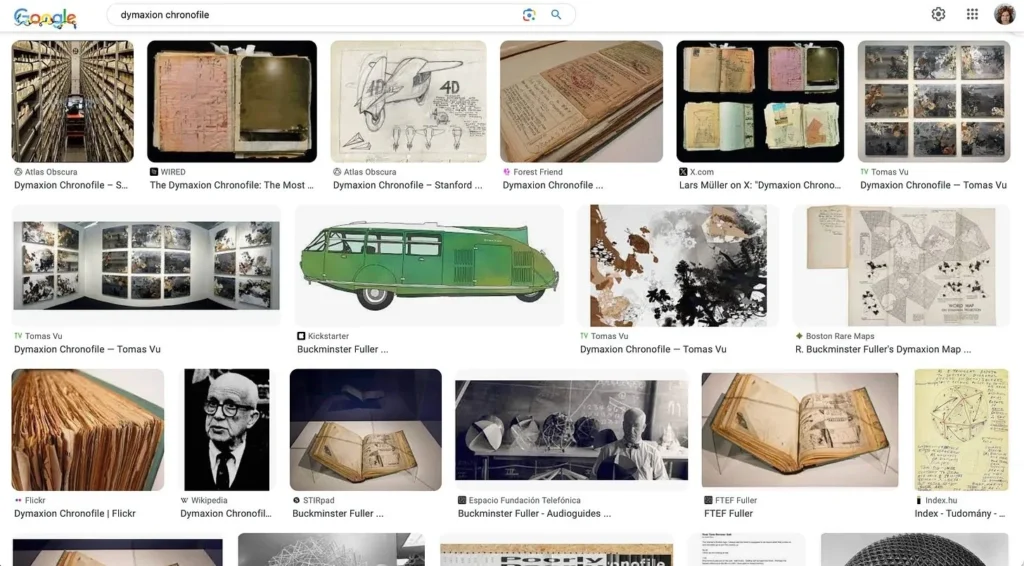
He was a brilliant inventor and artist and writer and is known largely as the creator of the geodesic dome. I could go on and on about him (and I probably will some other time) but for now I’ll explain that he too was an obsessive notetaker. He documented everyday of his life in something he called the Dymaxion Chronofile. His file includes “more than 140,000 papers and 1,700 hours of audio and video” (all of which are archived in physical form and take up 1,400 linear feet.) (4)
Google Search results for “dymaxion chronofile” December 4, 2023
All the more reason to go digital! I do not have that kind of space. 😂
But there’s something about analogue.
Writing things down engages a different part of the brain than typing. (5)
Not to mention the physical record and embodied act of moving around notes and seeing them in visual conversation with each other.
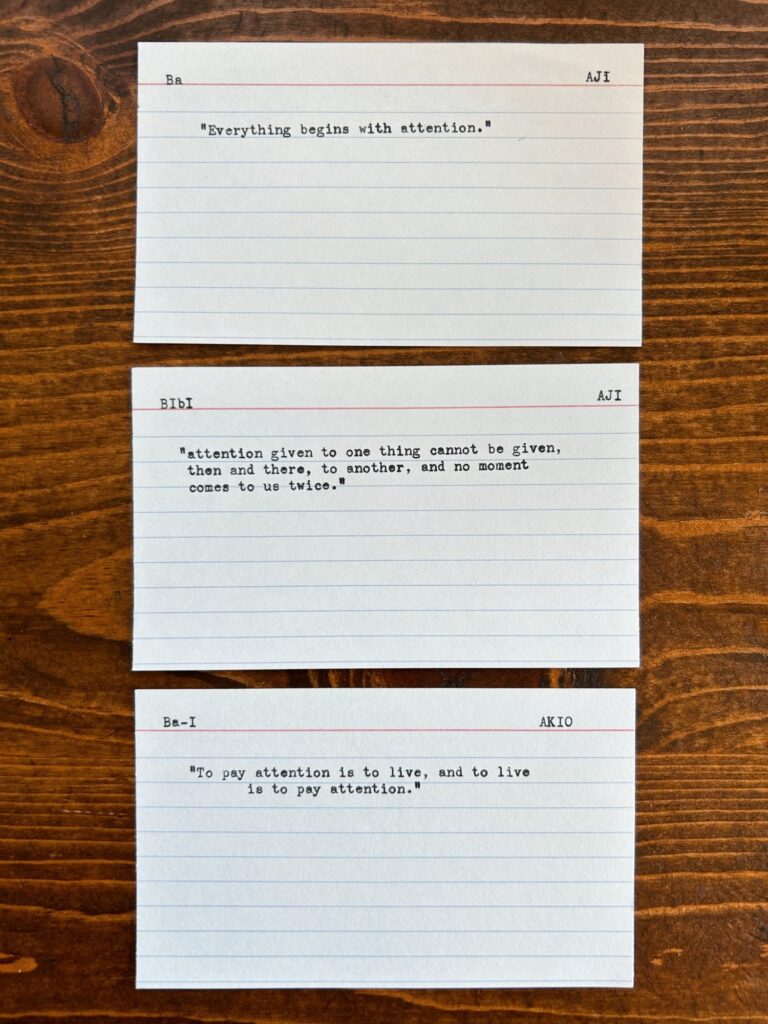
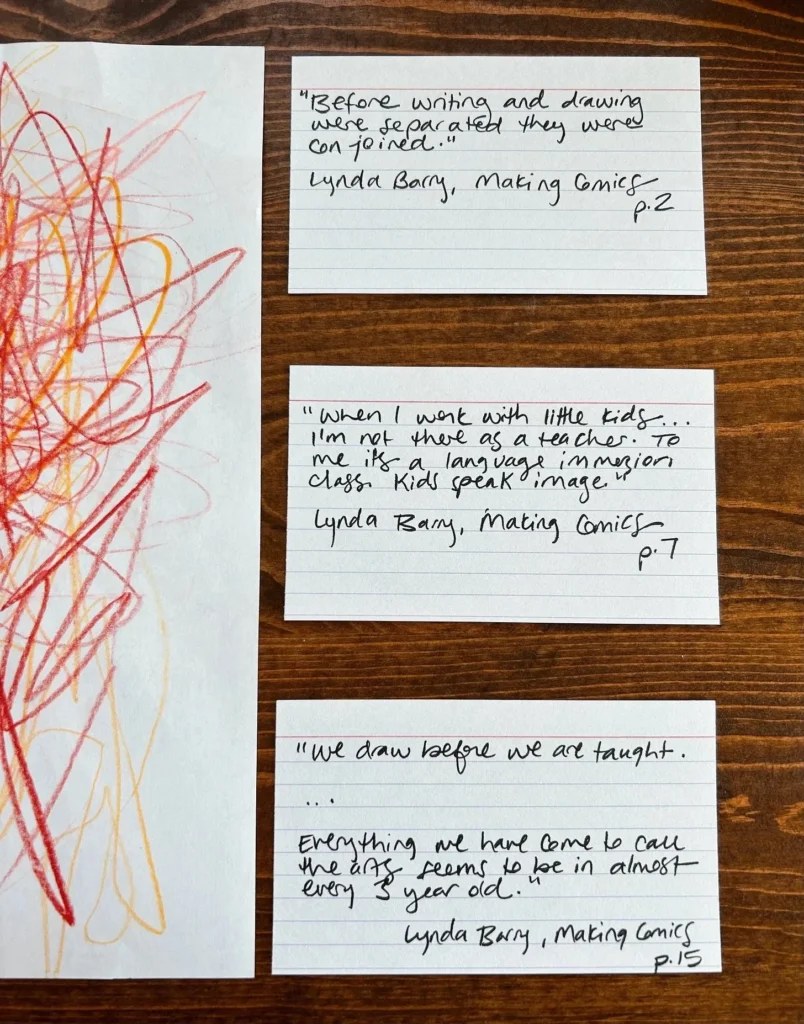
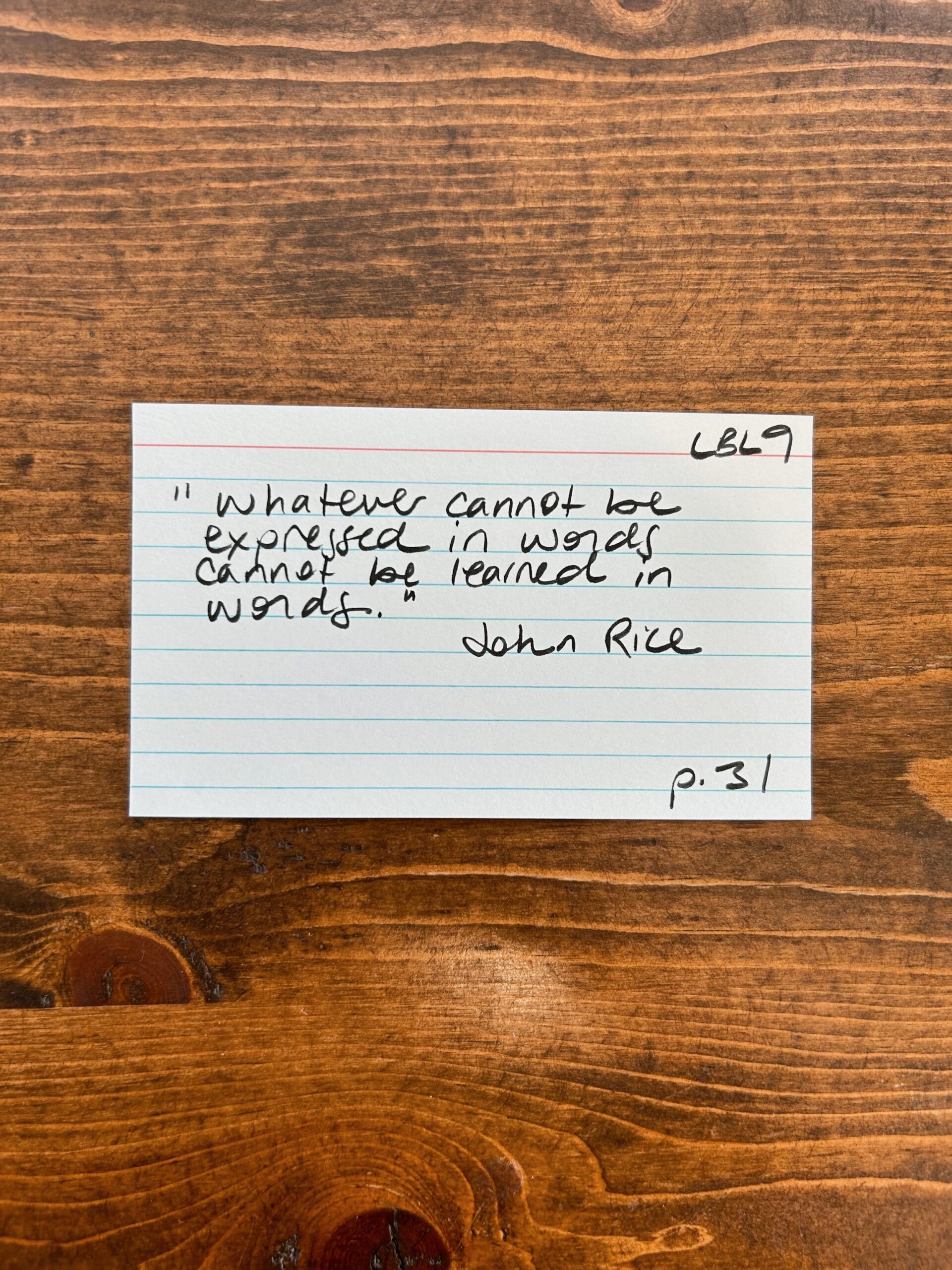
Physical notecards of my favorite quotes – in a card catalogue drawer, and a searchable digital archive – hosted on my own website.
I can easily type up notes on my phone (using the Squarespace app) and then later jot them down or type them onto a card for my physical file. This also adds a layer of curation for my physical chronofile.
It also means the letter and number codes (used above) are largely irrelevant due to the search-ability of my digital chronofile. Which is quite a relief because they never felt natural – just another outside system I was trying to use to reinvent the wheel. Why create analogue reference systems when digital search does that so easily?
I fully accept this process will shift and change. But what I’m trying to do is to utilize the best features of each medium.
Analogue for muscle memory. For embodiment. For serendipitous connections. And for aesthetic share-ability.
Digital for search-ability. For time lord technology (fitting a lot in quite a small physical space). And for the ability to include photos, videos, and audio files.
Embracing my inner Magpie
The real delight here is that scaling back my Substack publishing schedule has freed up bandwidth to rekindle my passion for research.
This hybrid system feels in alignment with my brain and the way it works and that makes all the difference.
The Saga Continues
One of the coolest things about Substack (or blogs) is that you can update posts as you have more information. Here’s a space I’m creating to do that as I evolve my note taking practice.
2/9/24: I’m experimenting with adapting this method to Obsidian. It resolves a few problems I was having with the Squarespace app and hosts everything locally instead of using my web hosting space. I may still use the Chronofile on my website occasionally as a microblog, but I’ve taken it off the site navigation for now.
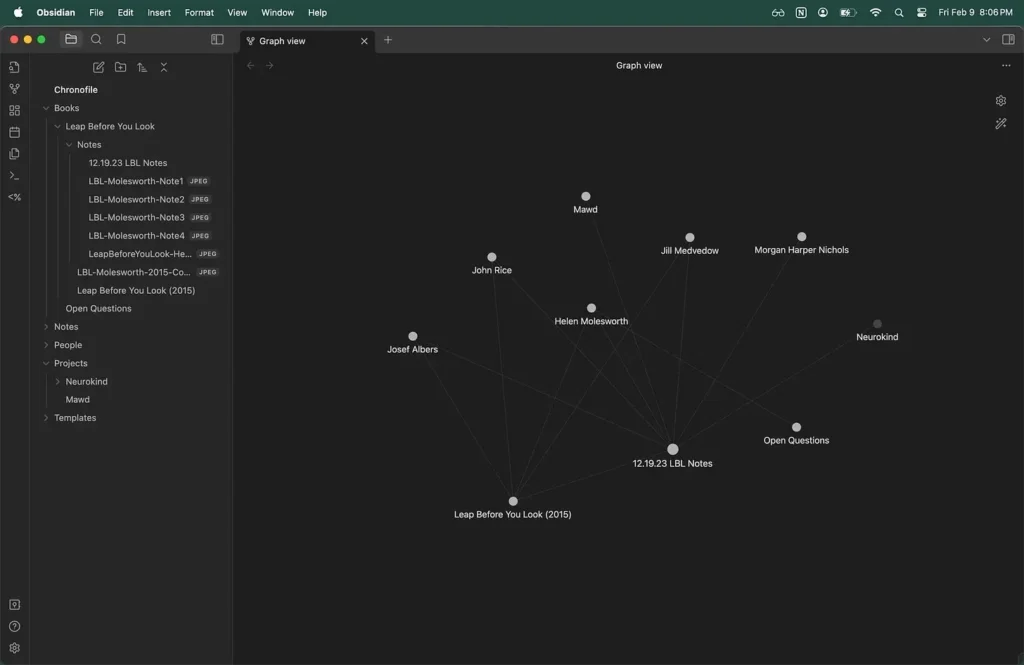
I’ll be honest I was drawn in by the constellation visuals (these are called graphs.) I saw this twitter thread from Morgan Harper Nichols and was immediately enchanted.
My own graphs are still small for now, but it’s cool seeing how ideas connect.
There are lots of aesthetic reasons I’m really enjoying the app, but from a practical side it makes sense too. Instead of uploading your data into an app you’re creating text files and nesting folders on your own computer.
This means if Obsidian goes defunct you’ll still have all of your notes.
And that’s the main reason I’m transitioning away from Notion.
The stars are just a bonus. 💫
Still here? You must be a creative kindred.
How do you collect notes and information?
Do you prefer analogue or digital or a bit of both?
Thanks for being here.
FOOTNOTES
I might have stuck with this one for simplicity sake, but around this time the paper and binding quality of composition notebooks went right down. I still remember the gummy goo of one particular notebook binding that peeled up. *shudders*
2. At least it is for me. Kudos to you if you’ve figured it out.
3. After watching every single one of the Vlogbrother’s videos I finally read John Green’s The Fault in Our Stars. And it felt like reading a book by a friend. I could see all of the random obsessions he’d had over the years come together in his book. The same for Hank Green’s An Absolutely Remarkable Thing.
4. Dymaxion Chronofile:an archive of nearly every day of Buckminster Fuller’s life. Atlas Obscura. July 11, 2013.