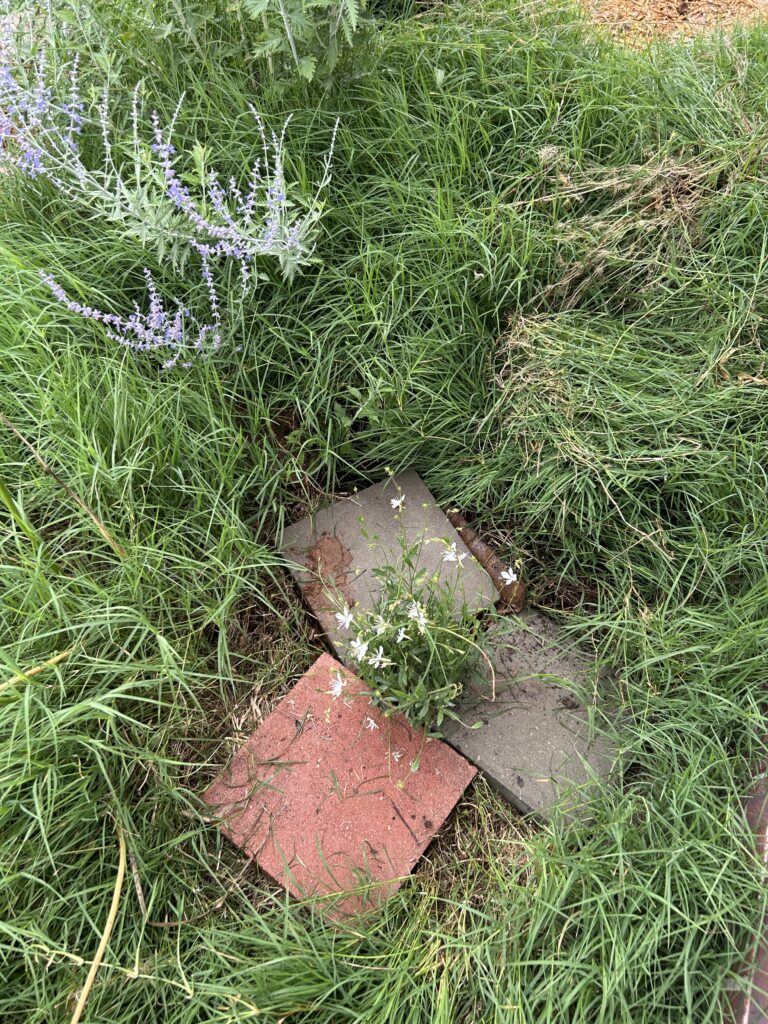
Real life chaos gardening for you. The back of the bed is overrun with grass so trying to defend this beauty with some spare stepping stones.

Real life chaos gardening for you. The back of the bed is overrun with grass so trying to defend this beauty with some spare stepping stones.
We’ve let the grass grow tall and planted wildflowers in 1/3 of our backyard… and it turns out the fireflies have moved in.
I walked out of the studio and this lovely flew all around me to say hello. We’ve been watching them every night.
Here’s a clip from the wildflower patch they are living in.
There’s a metaphor here about creating the right environment to invite magic. 💫
“What are we doing with all these links, anyway? We’re weaving the web tighter. Making introductions. Maintaining provenance. It’s meaningful, especially now, as AI systems work in the opposite direction: denaturing the links, melting down the chains of connection.”
“I feel really lucky that I had some good role models of people who seemed to be devoted parents and artists at the same time. I don’t think I needed so much to know how they did it — it seems impossible to generalize how one does it, because everyone’s context/family/situation is so wildly different — it was just enough to know that it could be done, that it was possible to be a decent parent and a decent artist at the same time, and that, maybe, being good at one could even help you be better at the other.”
I’ve had a tab open for kening zhu’s post about rituals vs. sprints for nearly a month. It reminds me about something Katherine May once said on a podcast* about the cycle of neurodivergent hyperfocus and recovery. Versus a neurotypical ideal of consistency. It’s something I am still figuring out. Having experienced burn out I find I need to be careful of flying too close to the sun. But trying to force a structure that doesn’t align with my capacity is also not right. I’d love to hear other thoughts on this.
* I can’t seem to find the podcast episode I’m talking about. 🤦
“a conscious choice to be happy is a form of resistance…”
“You’re allowed to cultivate joy. In fact, you need to, because our job is to build the world that we want.”
“How can queer art help us to survive, and maybe even fight back, during this bloody awful moment in history?
I’ve been asking myself some version of this question non-stop for ages, but I still don’t have any clear answers. What I do have is a bone-deep sense that we need to be twice as wild, twice as flagrantly ourselves — and at least three times as experimental, honest, and weird as before.”
“The best time to establish alternative, non-algorithmic networks of communication & affinity was five years ago.
The second best time is today!”
by Robert Olen Butler
“Please get out of the habit of saying that you’ve got an idea for a short story. Art does not come from ideas. Art does not come from the mind. Art comes from the place where you dream. Art comes from your unconscious; it comes from the white hot center of you.”
The concept of this book is that storytelling comes from your unconscious and not your logical mind. This tracks with the writing process of Ray Bradbury, Dorothea Brande, even Terry Pratchett. It also maps onto the concepts of “day brain” vs. “night brain” writing explored on the podcast Writing Excuses.
But the farther I read into this book the more rigid and didactic Butler’s approach seemed. He needlessly used plot examples requiring a content warning.
I can’t say I wholeheartedly recommend this book, but I do find this concept of taking space to “dream” a story before you write it both liberating and extremely challenging. After setting an intention for more reverie in 2025 I have instead completely rebuilt my website and migrated my newsletter. 🤷
But my best fiction has come from that place of the unconcious. So this is a technique I want to explore.
If you do read this book, take it with a grain of salt. Artists often sound as if their way is the only way because it is the way that works for them.
For their creative ecosystem.
What you or I need may be completely different.
With those caveats here are some passages I found interesting.
“Voice is the embodiment in language of the contents of your unconscious.”
Most artists spend a lot of time and energy trying to find / discover / hone their artistic voice or style. Whereas this suggests that leaning away from analysis and toward the unconscious may bring you closer to your true voice.
“What you forget goes into the compost of the imagination… in a compost heap, things decompose. Your past is full of stories that have been composed in a certain way; that’s what memories are. But only when they decompose are you able to recompose them into new works of art.”
Love a creative compost metaphor of course. He is paraphrasing British novelist Graham Greene here.
“The organic nature of art is such that within the process everything must be utterly malleable, utterly fluent, so that everything ultimately can be brought together; and if there’s anything in there that will not yield, is not open to change, you cannot create the object.”
This is something I’m finding in my own process. I come in with a concept for a story, but the more closely I hold myself within those bounds the worse the writing is. This past year my writing started to enter this dreamspace for the first time. I found the story was moving like shifting tetonic plates.
“Rewriting is redreaming.”
I think the most radical idea in this book is that even editing (normally considered an analytical process) can come from the unconscious.
And should in Butler’s opinion.
As a literature professor he has all the tools for analysis, but claims not to consciously use them. He rereads his books looking for “twangs” and redreams them until it all “thrums.” Even his rewriting process coming from the unconscious.
“The compost heap of the novelist, the repository that exists apart from literal memory, apart from the conscious mind, is mostly made up of direct, sensual life experience.”
More creative compost. Butler has an obsession with sensory details and decries all explanatory words (for emotions, etc.) and here is where you can fall into the trap of taking on his style for your own. Centering on sensory details can certainly make a text richer, but to use them exclusively feels extreme.
It’s a stylistic choice not “good” or “bad” writing as he frames it.
“[Fiction and technique] must first be forgotten…before they can be authentically engaged in the creation of a work of art.”
He’s basically explaining here that all of that analysis (of stories and literature and writing technique) goes in the compost heap and he doesn’t trust it until it’s filtered through dreamspace.
“Desire is the driving force behind plot.”
I think this comes to the heart of his dreamspace technique. Rather than plotting a work analytically (something I am apparently allergic to) he let’s the objective of a character drive the action. This prevents the awkward situation where a character simply does something because the plot requires it.
It’s a bit chicken and the egg.
I don’t think one way is right or wrong. But when you’re done your character had darn well better have a drive for what they are doing. But doesn’t it sound more fun to let character drive your writing rather than the other way around.
“Writers who aspire to a different kind of fiction— entertainment fiction, let’s call it, genre fiction—have never forgotten this necessity of the character’s yearning.”
He is a straight up literary snob here. 🙄
But it’s worth mentioning because this chapter reminded me of musical theatre structure.
Something strongly present in my personal compost heap.
There’s always an “I want” song in Act I.
“[The artist] doesn’t know what she knows about the world until she creates the object… the writing of a work of art is as much an act of exploration as it is expression, an exploration of images, of moment-to-moment sensual experience.”
I think a lot of writers sit down to “write a book” not to “discover a story.”
For all of my criticisms of this book I do think I’ve added some rich humus (with a pile of horse 💩) to my compost heap.
That said, I hesitate to give Butler too much credit. The reason I bought his book was that I was already curious about a more intuitive approach based on Ray Bradbury’s Zen and the Art of Writing.
I gave up marking quotes because I wanted to quote every other line. And ended up too intimidated to write about it at all. Which now feels silly because I’m writing about this book that is a dim reflection of it.
Bradbury very much wrote from this dreamspace and drawing images and characters from his unconcious. I just need to find the fortitude to do it justice when writing about it.
Maybe next month.
Photo Credit: Patrick McManaman