From the Compost Heap header. A pencil style illustration of a compost heap with flowers and plants growing around it. A bee buzzes by and a white rabbit hops by.
  • Brain Fog ☁️

    I’m entering my 7th year of parenting.

    How did that happen?

    Within a year of giving birth I started making art to process my experience. That was the beginning of This is My Brain on Motherhood.

    Seven years later, I think I’ve fully integrated the identity of parent.*

    Which means I’d like to complete this collection, celebrate it somehow, and then move on to making art on other themes (like neurodivergence or perhaps chronic illness.)

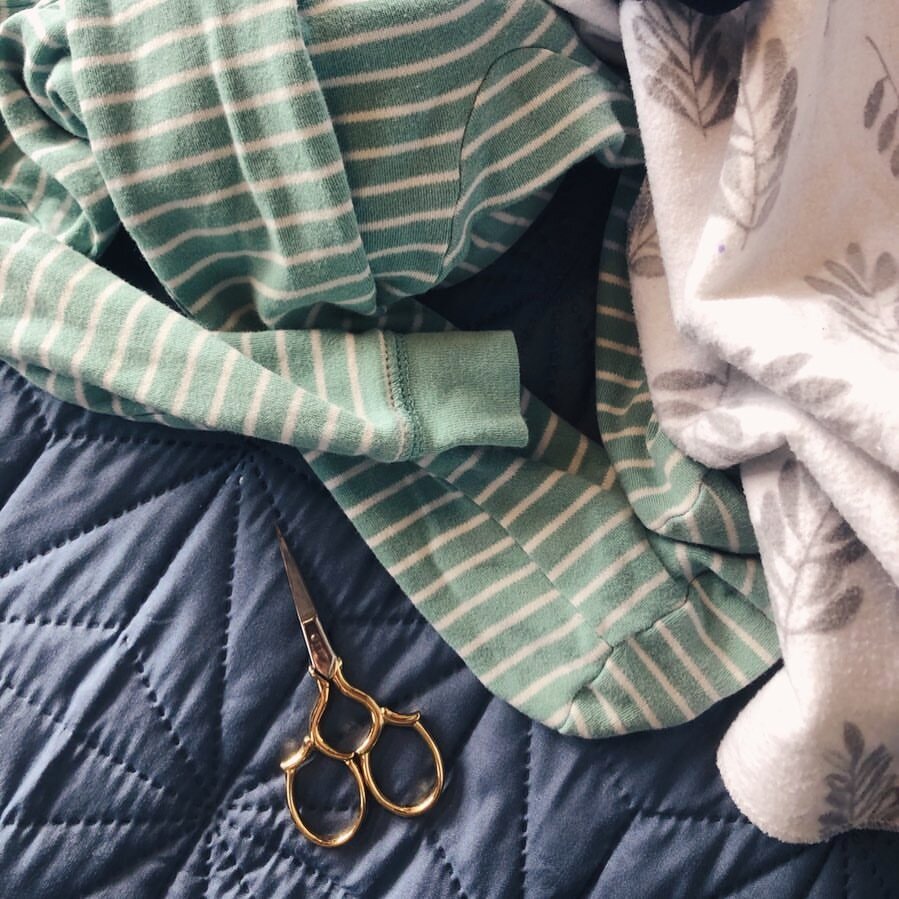
    Gold scissors and baby clothes on a blue blanket

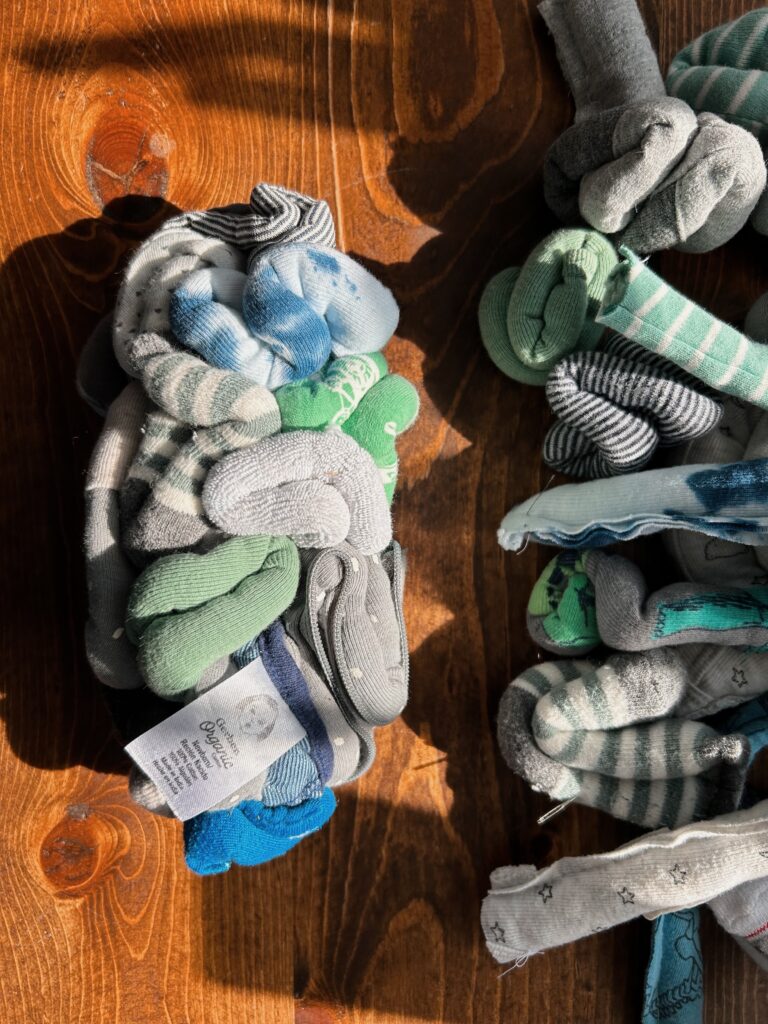
    One of the pieces I’ve struggled to complete is a soft sculpture brain made with baby clothes. From the first little brain noodle (the white washcloth center of the left hemisphere) I had the vision.†

    But sewing through layers of fabric is hard on the hands and pretty quickly I had split my skin and it was too painful to continue. I finally realized the easy injury and slow healing was due to a connective tissue disorder (more on that soon).

    I tried every thimble under the sun and none of them were dexterous enough to give me the fine motor control I wanted. I put the project down for months on end and picked it up a bit here and there – always ending up a little worse for wear after working on it.

    Eventually I discovered the needle puller from Mx. Domestic (shown above!) and was able to sew the second hemisphere of the brain.

    But I still felt stuck. It took a while to realize why. The form was coming together, but I was lost on its purpose. I still had no clarity on what the brain was meant to represent.

    It all felt a little too sentimental to be fine art, but too weird to not be.

    Sometimes my art begins with a concept I want to represent. Other times I start with the form first and find the meaning during the process.

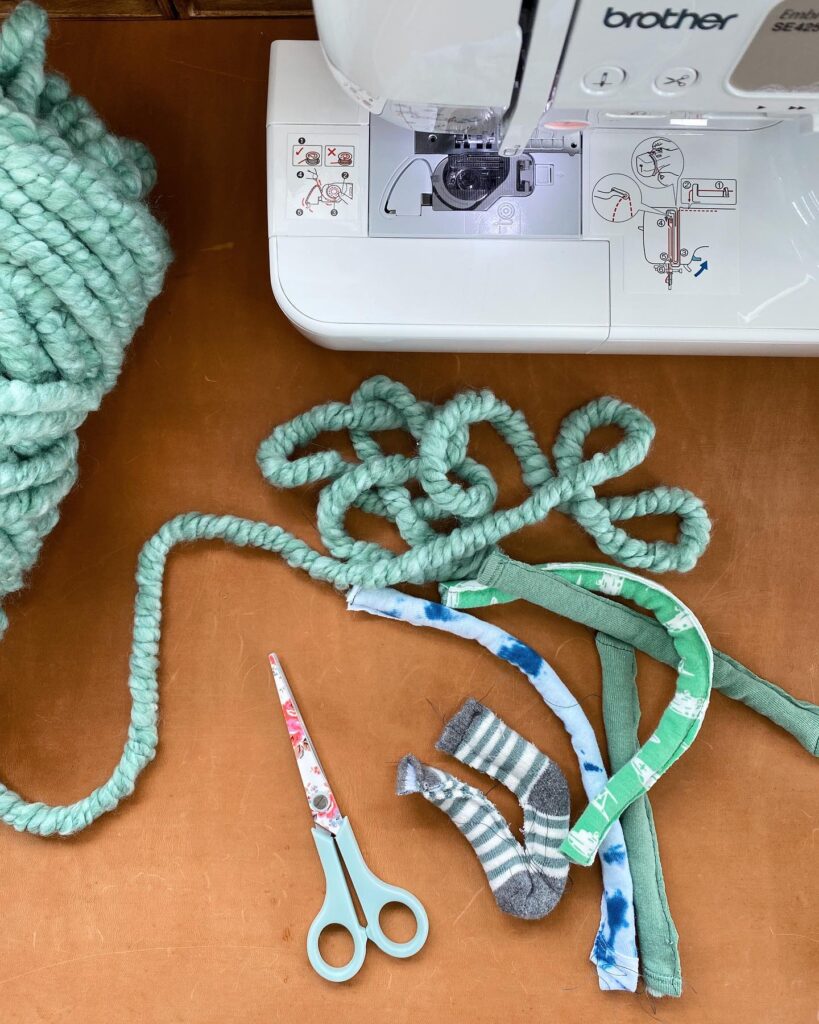
    Workspace with sewing machine, scissors, chunky yard, and a baby sock which has been cut in half lengthwise.

    Least week, I saw an upcoming deadline for a project about chronic illness. And I suddenly realized, with a few changes, this piece has the potential to represent brain fog. A symptom of new motherhood and hEDS (one of my new chronic illness diagnosis’.)

    Instead of a complete brain my vision is now for half wool roving to spill out representing brain fog.

    Ending with this piece feels very full circle.

    It wasn’t my first work about motherhood, but was certainly one of the earliest. This piece held space for me to reflect as I sewed scraps of newborn onesies, toddler tees, and tiny socks.

    Having a connection to chronic illness – a theme I’d like to explore next – feels right. Perhaps this will even be a work that belongs in both collections.

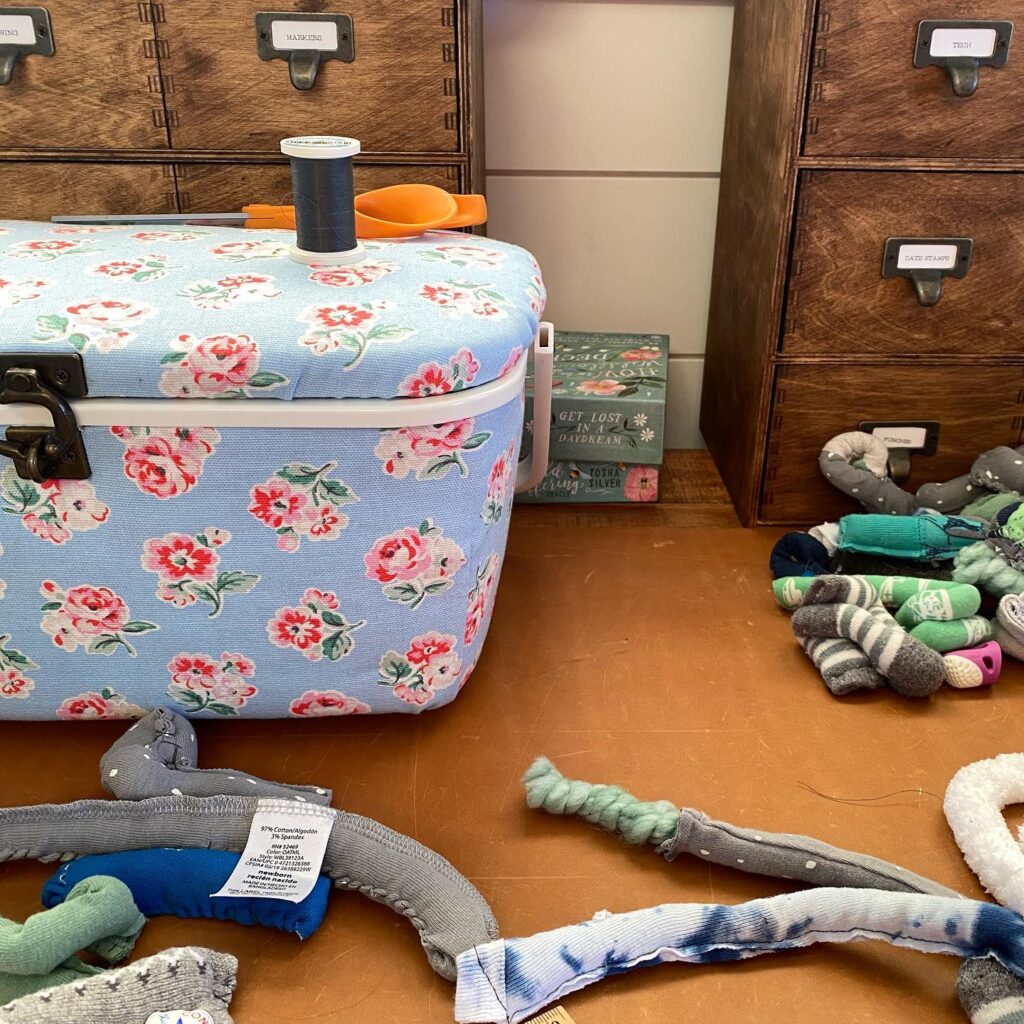
    Blue sewing kit on a desk covered with snippets of chunky yarn encased in scraps of baby clothes.

    This is My Brain on Motherhood was created as part of my Artist’s Residency in Motherhood. ARIM is a free open source framework anyone can participate in created by interdisciplinary artist Lenka Clayton.

    I’ve intended to write a blog post about ARIM for oh, six or seven years. At this point I’ll probably give it a few months and write a full retrospective.

    This body of work was created with the intention of eventually hosting a solo art show. A pop up where I hung my art in my house and invited a handful of friends over to see it.

    Little did I know my art would travel to galleries across the U.S. and even be exhibited in New York City.

    I have other visions now, for celebrating the collection virtually, in a form that isn’t geographically limited.

    But I’m still working out the details.

    Would you be interested in…

    • “This is My Brain on Motherhood” art book / monograph
    • set of postcards
    • art prints
    • virtual artist talk

    If so hit reply and let me know!

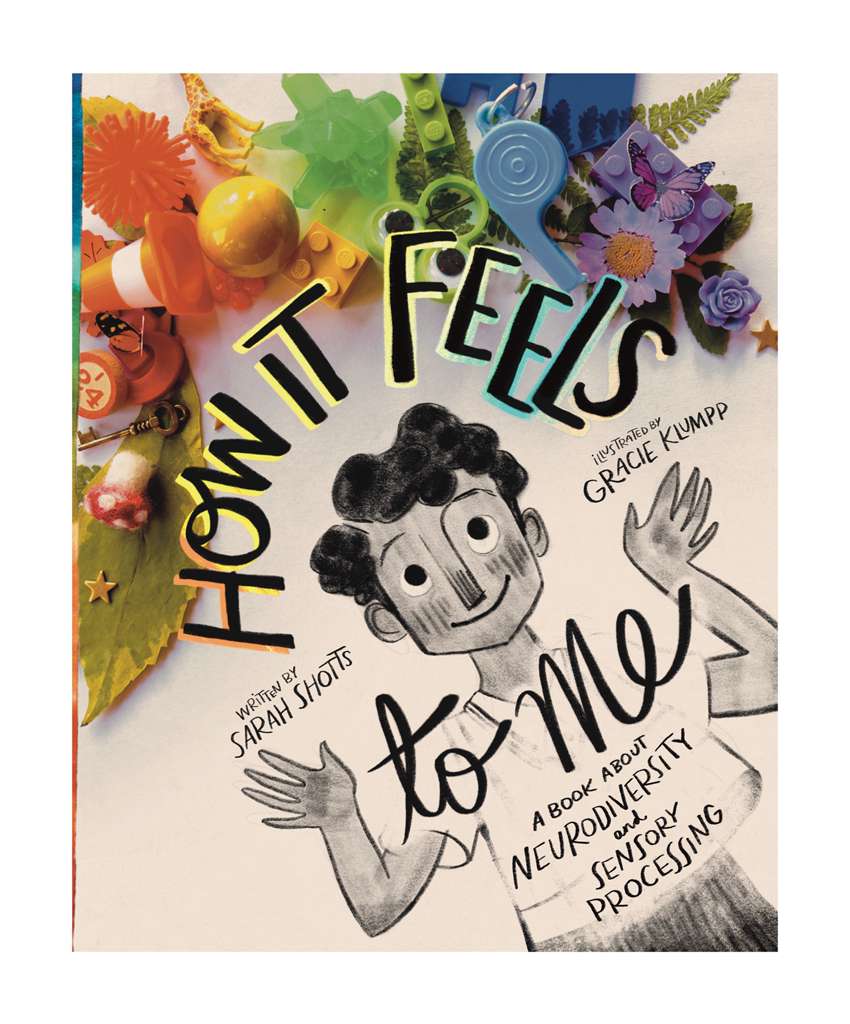
    This project would be slotted for autumn or winter (after the summer book launch for How it Feels to Me.)

    Soft sculpture of a brain made from baby clothes. One hemisphere is sewn from baby socks, onesies and washclothes. Scraps sit on a wooden table to the side.

    I’ll be back next week with more neurodiversity chat.

    Perhaps literally! I’ve been working on a new podcasting set up.

    If there’s a topic you’d like me to cover send me a note and let me know.

    Thanks always for your support.

    Cheers,

    Sarah signed with a swoopy S

    FOOTNOTES

    * I knew autistics struggled with transitions, but this was one heck of a transition. I did NOT expect it would take this long to exit “crisis mode” and feel like I’m a person again. Nevertheless, I’m glad that making these pieces and creating Entwined & Ember were portals for me to explore the identities of mother and parent and what they means for me.

    † Shoutout to Mindy Sue Meyers for hosting the soft sculpture workshop and for encouraging me – even when I completely ignored her instructions and took things in my own direction.

    Read more: Brain Fog ☁️
  • Gardening Resources

    How to Plant Your First Garden 🌱 via Dark Properties

    Advice for Starting No Dig 🥕 via Charles Dowding

    Find Your Last Frost Date ❄️ via Almanac.com

    Read more: untitled post 156078847
  • Fiction has an incredible transformative power. Just because it is quiet and gentle and mostly invisible to the eye does not mean it is not there, this inner strength.

    Elif Shafak

    Source: Fiction changes us from within.

    Read more: untitled post 156078842
  • “I feel really lucky that I had some good role models of people who seemed to be devoted parents and artists at the same time. I don’t think I needed so much to know how they did it — it seems impossible to generalize how one does it, because everyone’s context/family/situation is so wildly different — it was just enough to know that it could be done, that it was possible to be a decent parent and a decent artist at the same time, and that, maybe, being good at one could even help you be better at the other.”

    Austin Kleon

    Read more: untitled post 156078309
  • I’ve had a tab open for kening zhu’s post about rituals vs. sprints for nearly a month. It reminds me about something Katherine May once said on a podcast* about the cycle of neurodivergent hyperfocus and recovery. Versus a neurotypical ideal of consistency. It’s something I am still figuring out. Having experienced burn out I find I need to be careful of flying too close to the sun. But trying to force a structure that doesn’t align with my capacity is also not right. I’d love to hear other thoughts on this.

    * I can’t seem to find the podcast episode I’m talking about. 🤦

    Read more: untitled post 156078307
  • “a conscious choice to be happy is a form of resistance…”

    “You’re allowed to cultivate joy. In fact, you need to, because our job is to build the world that we want.”

    AOC via Amelia Greenhall

    Read more: untitled post 156078303
  • “I believe in the core of my being is that art can help reach people where political rhetoric and facts can’t. There’s something magical about identifying with a fictional character, or getting swept up in a story, or just being shocked by a piece of weird art into seeing things in a different way.”

    Charlie Jane Anders

    Read more: untitled post 156078301
  • “How can queer art help us to survive, and maybe even fight back, during this bloody awful moment in history?

    I’ve been asking myself some version of this question non-stop for ages, but I still don’t have any clear answers. What I do have is a bone-deep sense that we need to be twice as wild, twice as flagrantly ourselves — and at least three times as experimental, honest, and weird as before.”

    Charlie Jane Anders

    Read more: untitled post 156078299
  • “The best time to establish alternative, non-algorithmic networks of communication & affinity was five years ago.

    The second best time is today!”

    Robin Sloan

    Read more: untitled post 156078297
  • One of the many reasons I love The Wheel of Time.

    “There are a few basic themes that I think are pretty immutable, however. And the biggest one is: sometimes it is hard to understand people who were raised in a culture totally different from your own, but it is vital to try because we all fight together or we shatter.

    The show gets this 100%.”

    Bree via Bluesky

    Read more: untitled post 156078835